Orlestone Parish Council – Position Statement
Orlestone Parish Council – Position Statement
Objection to Further Residential and Commercial Development within the Parish of Orlestone
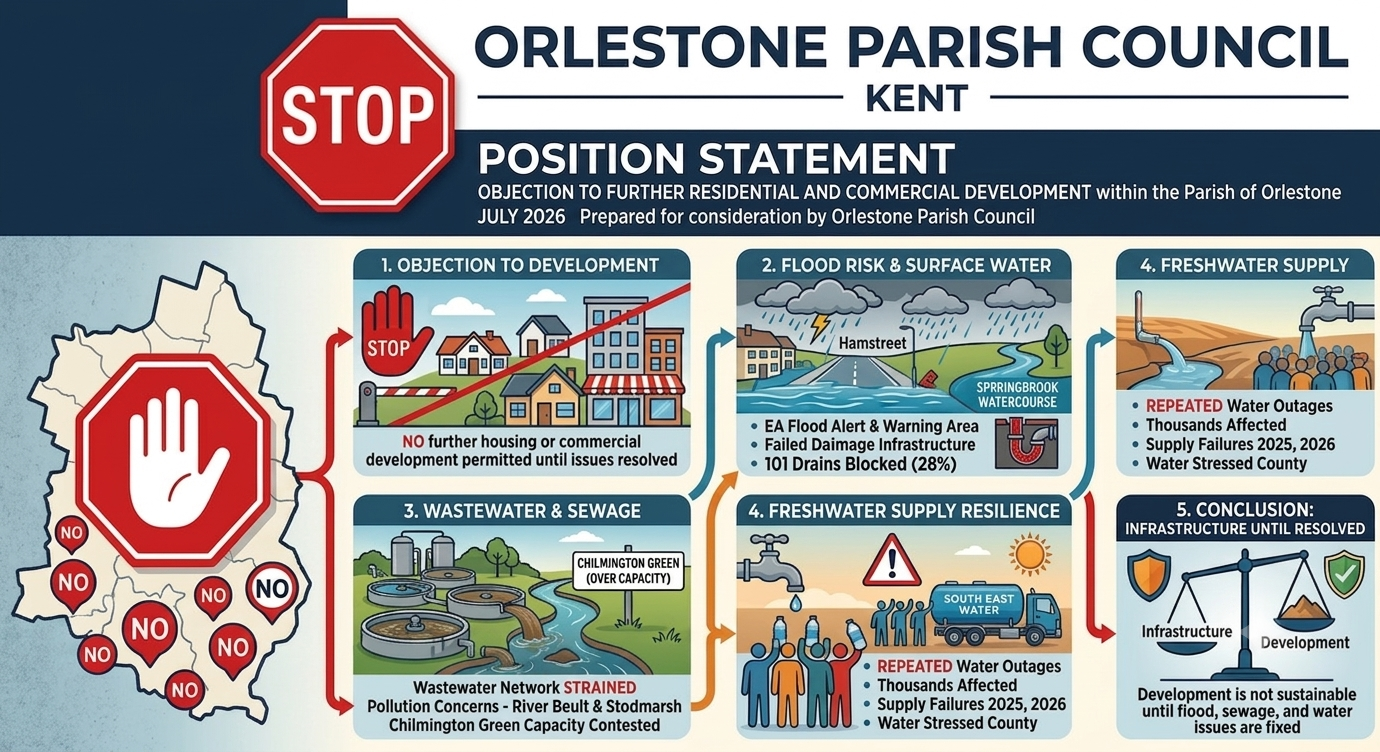
Purpose of this Statement
Orlestone Parish Council (“the Council”) has prepared this statement to set out its formal position that no
further housing or commercial development should be permitted within the Parish until three fundamental
infrastructure constraints are demonstrably and sustainably resolved: surface water flooding,
wastewater/sewage treatment capacity, and freshwater supply resilience. This is not a position taken lightly. It
reflects a consistent and worsening pattern of evidence, much of it drawn from the Council’s own records,
from Southern Water, from South East Water, and from Ashford Borough Council (ABC) itself, that the
existing infrastructure serving the Parish and the wider borough is already failing to cope with current demand.
Adding further dwellings before these deficiencies are fixed would place existing residents, as well as any new
occupiers, at unacceptable and foreseeable risk.
The Council submits this statement for consideration in respect of the Ashford Local Plan review, any
emerging Neighbourhood Plan, and any individual planning applications affecting land within the Parish. It
draws on national planning policy (the National Planning Policy Framework, paragraphs on flood risk and
infrastructure delivery) which is clear that development should not be permitted where it cannot be adequately
served by
Summary of the Council’s Position
Orlestone Parish Council (“the Council”) has prepared this statement to set out its formal position that no
further housing or commercial development should be permitted within the Parish until three fundamental
infrastructure constraints are demonstrably and sustainably resolved: surface water flooding,
wastewater/sewage treatment capacity, and freshwater supply resilience. This is not a position taken lightly. It
reflects a consistent and worsening pattern of evidence, much of it drawn from the Council’s own records,
from Southern Water, from South East Water, and from Ashford Borough Council (ABC) itself, that the
existing infrastructure serving the Parish and the wider borough is already failing to cope with current demand.
Adding further dwellings before these deficiencies are fixed would place existing residents, as well as any new
occupiers, at unacceptable and foreseeable risk.
The Council submits this statement for consideration in respect of the Ashford Local Plan review, any
emerging Neighbourhood Plan, and any individual planning applications affecting land within the Parish. It
draws on national planning policy (the National Planning Policy Framework, paragraphs on flood risk and
infrastructure delivery) which is clear that development should not be permitted where it cannot be adequately
served by
- The Parish, and Hamstreet in particular, is a designated Environment Agency flood risk area, with a
recorded history of surface water and watercourse flooding that recent inspections show is being made
worse by inadequately maintained drainage infrastructure. - Southern Water’s wastewater network and treatment capacity in the wider Ashford area are already
operating under significant strain, to the extent that a major new sewage treatment works has had to be
proposed, contested, and fought through appeal simply to accommodate development already
consented at Chilmington Green — with no assurance that capacity exists for further growth beyond it. - Ashford Borough has been directly affected, repeatedly and recently, by potable water supply failures,
with thousands of households across the borough left without running water or on emergency bottled
supplies during 2025 and again in 2026. - Taken together, these three strands demonstrate that essential infrastructure in and around the Parish is
at or beyond capacity. The Council considers that permitting further development now would be
contrary to the presumption that development should be sustainable and adequately serviced.
Flooding and Surface Water Drainage
The Parish sits within an area that the Environment Agency formally recognises as prone to flooding. The
Speringbrook watercourse through Hamstreet is subject to both a Flood Alert and a full Flood Warning
designation, meaning the Environment Agency considers flooding not merely possible but, at times, expected
and requiring immediate action.
The Environment Agency (EA) recognises that the Speringbrook is an area prone to Flooding and monitors
it… Flood Warning Name: Speringbrook Sewer (Hamstreet Arm) – Speringbrook Sewer Hamstreet Arm,
between The Street and Bournewood.
— Orlestone Parish Council, “Flood Wardens”, orlestoneparish.co.uk
The Council’s own investigations into the causes of flooding after heavy rain have identified serious
shortcomings in the maintenance of the highway drainage network on which the Parish depends. Of the 364
road drains and gullies on the three main roads leading into Hamstreet, over a quarter were found to be blocked
at the time of inspection:
One of the contributory factors to flooding after the rains is the efficiency of the road drains/gullies to
remove it… we have 364 of these drains/gullies throughout the village. Of these 101 have been reported as
blocked (28%!!).
— Orlestone Parish Council, “Flooding Issues”, orlestoneparish.co.uk
This is not a historic or resolved problem. The Council has established a Flood Warden scheme and continues
to hold regular meetings and training specifically because flash flooding and highway surface water flooding
remain live, recurring hazards in the village. Any additional hard-standing, roofing, or run-off generated by
new development — without proven, funded, and delivered betterment of this drainage network — can only
increase the frequency and severity of flooding for existing residents and any new occupiers alike.
Wastewater and Sewage Treatment Capacity
The clearest evidence that wastewater infrastructure serving the Ashford area is already overstretched is the
protracted and highly contested saga over the new sewage treatment works required to serve the South of
Ashford Garden Community at Chilmington Green, a matter which speaks directly to the capacity available
for any further development, including within Orlestone Parish.
The existing Southern Water network could not accommodate the wastewater from homes already consented
at Chilmington Green because of the impact on the Stodmarsh nature reserve, a protected site already suffering
nutrient pollution from wastewater run-off across east Kent:
Problems relating to the impact of wastewater on the Stodmarsh Nature Reserve near Canterbury prevented
the new estate from using the existing Southern Water facility.
— KentOnline, October 2024
A new, standalone treatment plant was therefore proposed on land west of Chilmington Green. Ashford
Borough Council itself refused the application, citing concerns including odour, before the decision was
overturned on appeal by the Planning Inspectorate — against the wishes of residents and the local planning
authority. Objectors including the Kent Wildlife Trust and the South East Rivers Trust warned of serious
ecological risk to the River Beult from nutrient pollution and untreated sewage during flood conditions:
This fragile ecosystem could suffer from nutrient pollution, untreated sewage during floods, and
contamination affecting livestock and farmland. The Environment Agency must act to protect this vital
habitat and prevent long-term environmental damage.
— Kent Wildlife Trust, cited in KentOnline, January 2025
Even the mechanism for operating the new works has been challenged as uncertain, with one objector noting
the scheme depends on three separate organisations — Southern Water, Severn Trent Connect, and
Independent Water Networks Ltd — working together, with no clarity on accountability if something goes
wrong. This is the infrastructure that only just — and controversially — secures capacity for housing already
committed nearby. It provides no basis for confidence that spare capacity exists to serve further development
in Orlestone Parish, and every indication that the network is already being run at, or beyond, its safe limits.
This local picture is consistent with Southern Water’s wider record across the region, where storm overflows,
sewage spills, and treatment works upgrades driven by regulatory enforcement (including a record fine in 2021
for deliberate dumping of raw sewage) point to a company managing chronic capacity shortfalls rather than
one with headroom to spare.
Freshwater Supply Resilience
Ashford Borough has, within the last twelve months, experienced repeated and serious failures of potable water
supply, underlining that the drinking water network — as well as the wastewater network — is already under
acute pressure.
In late 2025, a major failure at South East Water’s Pembury treatment works, caused by contamination of the
treatment process, left tens of thousands of properties across the wider area without running water or under a
boil-water notice for nearly two weeks, with local businesses estimated to have lost up to £8 million:
Towards the end of 2025, approximately 24,000 properties across Kent and East Sussex were without
running water for nearly two weeks, with local businesses suffering estimated losses of up to £8million.
— GB News, May 2026
The problem recurred in the Ashford area itself in May 2026, when a heatwave triggered supply outages across
villages including Charing, Challock and Molash — all within a few miles of the Parish — with hundreds of
properties left without running water and emergency bottled-water stations set up for residents:
Residents in three villages near Ashford – Charing, Challock and Molash – began experiencing no running
water or low pressure… At the height of the issues, South East Water said around 800 households were
affected.
— KentOnline, May 2026
South East Water subsequently warned that supply might have to be cut to thousands more homes as reservoirs
ran dry under high demand, with 7,000 customers across the Ashford area and surrounding villages already
experiencing low pressure or intermittent supply, and the company’s own chief executive and chairman
departing amid sustained criticism of its performance:
There are currently 7,000 customers experiencing low pressure or an intermittent supply in Tankerton,
Ashford and its surrounding areas, Ulcombe, Cranbrook, Coxheath and Headcorn.
— GB News, May 2026
Kent is formally recognised as a water-stressed county, and while South East Water has recently brought
forward new treatment capacity intended eventually to benefit Ashford, that investment is described even by
the company as one of “several crucial infrastructure improvements” still required, not a solved problem.
Against this backdrop of demonstrable, repeated, and recent failure to guarantee a reliable water supply to
existing customers, the Council d
Conclusion and Requested Action
Orlestone Parish Council recognises the pressure to deliver new homes across the borough. However, the
Council’s position is that sustainable development cannot be divorced from the infrastructure required to
support it. On the evidence set out above — recurrent flooding and a drainage network with documented
maintenance failures; a wastewater network so constrained that new treatment capacity had to be fought
through appeal merely to serve already-committed housing; and a freshwater supply network that has left tens
of thousands of Kent households without water on multiple occasions in the past year — the Council does not
consider that the Parish, or the wider Ashford area, has the infrastructure headroom to support further
development at this time.
The Council therefore formally objects to further residential or commercial development within Orlestone
Parish and requests that Ashford Borough Council, Southern Water, and South East Water:
- Provide a transparent, independently verified assessment of current spare capacity in the surface water
drainage, foul sewerage, and potable water networks serving the Parish before any further allocations
are considered; - Commit to a clear “no further connections without upgrades” principle, mirroring commitments sought
elsewhere, so that no new development is permitted to add load to networks already operating beyond
safe capacity; - Fund and deliver outstanding highway drainage maintenance in Hamstreet, including clearance of all
reported blocked gullies, as a precondition of any further planning consents; and - Report publicly and regularly to the Council on progress against each of the above.
The Council reserves the right to submit further, site-specific objections as any individual planning applications come forward, and requests that this statement be treated as a standing material consideration in respect of all development proposals affecting the Parish.
Sources referenced above include Orlestone Parish Council (orlestoneparish.co.uk), KentOnline, GB News, and the BBC. This statement should be reviewed and formally adopted at a meeting of the Council prior to submission.